Stress Relief at Work: Quick Desk Breaks to Reset Your Day
In this article
The quickest stress relief at work comes from short, repeatable breaks: slow your breathing, move your body for a minute, and give your eyes and mind something lighter to do before diving back in. You don't need a day off or a quiet room. A handful of two-minute resets, used throughout the day, can keep the pressure from piling up.
Why work stress builds up (and sneaks up on you)
A workday rarely gives you a natural pause. One task runs into the next, notifications keep arriving, and lunch becomes a sandwich at your keyboard. Without small breaks, your body stays in "go" mode for hours, and tension gathers quietly in your shoulders, jaw and breathing.
The fix isn't a dramatic change. It's noticing the warning signs early, a tight neck, a short temper, a foggy head, and stepping off the treadmill for a minute or two before you feel completely drained. Think of these breaks as maintenance, not a reward you have to earn.
Fast stress relief at work you can do at your desk
These take between thirty seconds and five minutes. Pick a couple that fit your day and use them often.
Reset your breathing
When you're stressed, your breath gets shallow and fast. Slowing it down is the quickest signal to your body that you're safe.
- Box breathing: in for 4 counts, hold for 4, out for 4, hold for 4. Two or three rounds is enough.
- Longer exhale: breathe in through your nose, then let the out-breath last a little longer than the in-breath. No counting needed.
You can do this between meetings, on mute during a call, or while a page loads. Nobody has to know.
Stand up and move for sixty seconds
Sitting still for hours stiffens everything. Once an hour, stand up, roll your shoulders back, reach your arms overhead, and gently turn your head side to side. If you can, walk to get water or step outside for a breath of fresh air. Movement resets your posture and your mood at the same time.
Rest your eyes
Screen fatigue adds to the feeling of being wired and tired. Every so often, look away from the monitor at something far across the room or out a window for twenty seconds. Blink slowly a few times. Small, but it genuinely takes the edge off.
Take a real micro-break for your mind
Pushing through without a mental pause often makes the next hour slower, not faster. A short, absorbing micro-break lets your focus recover so you come back sharper.
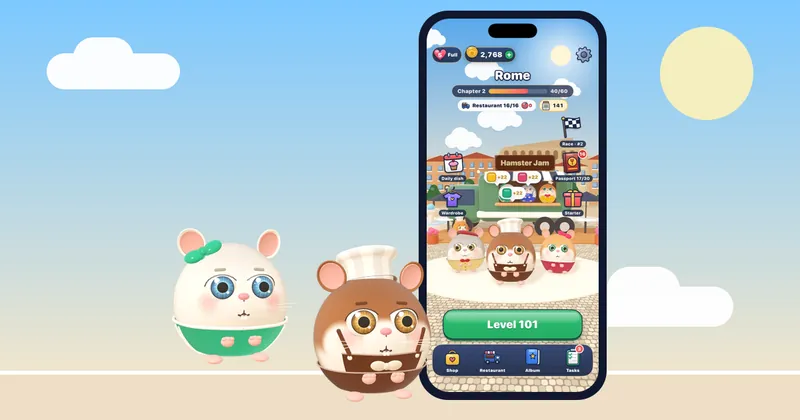
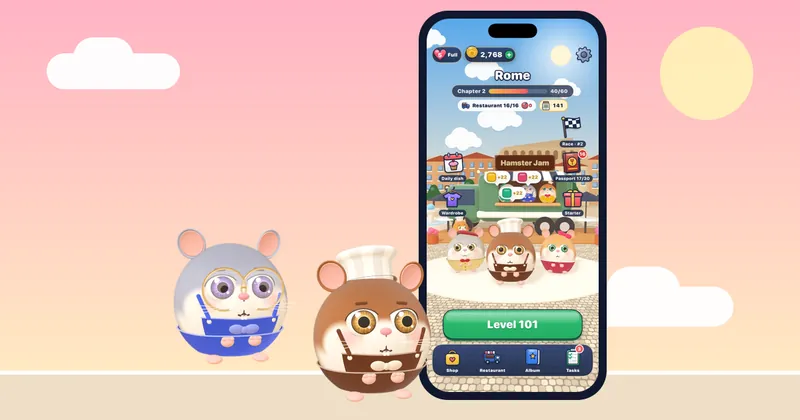
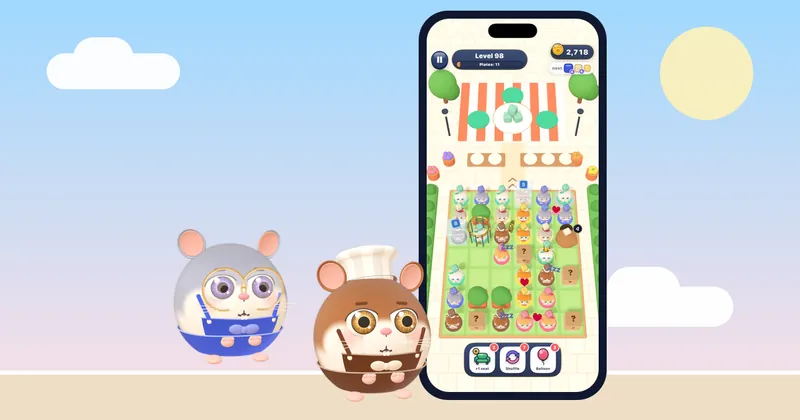
A cozy puzzle game works well here because it's easy to start, easy to stop, and asks for just enough attention to pull your mind off the deadline. Hamster Jam is a free food sort puzzle for iPhone built around exactly that kind of gentle focus. The hamster gang is hungry and the street is jammed; you tap a hamster whose path is clear and it hops off to its favourite dish, and your job is simply to keep the waiting bench from filling up.
Why it suits a work break:
- No timers on your fun, so a break never becomes another thing racing against the clock.
- Every level is solvable, because the hundreds of levels are hand-checked, no frustration to carry back to your desk.
- Works offline, handy in buildings with patchy Wi-Fi.
- Gentle and non-violent, with six calm little heroes like unhurried Vanilla and mellow Minty.
Play one level, then set the phone down and get back to it. If you'd like to try the feel without installing anything, you can play a quick level of the hamster puzzle right in your browser.
Tidy one small thing
A cluttered desk quietly raises the background noise in your head. Spend ninety seconds clearing one corner: stack the papers, rinse the mug, close the extra tabs. Finishing one tiny task gives a satisfying sense of order that carries into the next job.
Write down what's looping
If the same worry keeps circling, jot it on a sticky note or in a quick list: "call back the supplier," "ask about Friday." Getting it out of your head and onto paper means your brain can stop rehearsing it, and you can decide when to actually deal with it.
Build breaks into the shape of your day
One-off resets help, but a little structure helps more. A few ideas that fit most jobs:
- Pair breaks with things you already do. Breathe while the kettle boils. Stretch after every call. Stand up every time you send an email you were dreading.
- Protect your lunch. Even twenty minutes away from the screen, ideally with a short walk, changes the whole afternoon.
- Use a gentle timer. A quiet nudge once an hour reminds you to unclench your shoulders and look away from the screen.
- Set a clear end to the day. A small ritual, closing the laptop, a deep breath, a short walk, tells your brain that work is done. For more on this, see our guide to simple ways to relax and unwind after a long day.
The aim isn't to add more to your plate. It's to spread small pauses through the day so stress never gets a running start.
When a quick break isn't enough
If you find yourself relaxed in three minutes flat, our collection of tiny resets you can do in five minutes has even more ideas for busy days. And since work stress has a habit of following you home, it helps to have an evening wind-down too, our guide to winding down before bed for better sleep is a good place to start.
That said, these are everyday tools for everyday pressure. If work stress has been heavy for weeks, is affecting your sleep or mood, or is spilling into the rest of your life, it's worth talking to a doctor or a mental health professional. Looking after your wellbeing is part of doing good work, not a distraction from it.
Start small. Choose one or two of these resets, use them today, and let them become a habit. Stress relief at work is less about one big fix and more about many tiny pauses that keep you steady.
Questions
What is the fastest way to relieve stress at work?
Slow breathing is usually the quickest option because you can start instantly without leaving your chair. Try a couple of rounds of box breathing, or simply make your out-breath longer than your in-breath. Pairing it with a quick stand-and-stretch or a short walk to get water helps you feel the difference even faster.
How often should I take breaks during the workday?
A short pause every hour or so works well for many people, plus a proper break at lunch. The breaks don't need to be long: sixty seconds to stand, stretch and look away from the screen is enough to reset your posture and focus. The key is frequency, not length.
Can playing a quick game help with work stress?
It can, if the game is calm and easy to put down. A cozy, low-pressure puzzle gives your mind a short break from the task in front of you without winding you up. Hamster Jam is one example: a free food sort puzzle with no timers on your fun, hand-checked levels that are always solvable, and an offline mode, so one level makes a tidy micro-break.
What should I do if work stress won't go away?
Everyday resets like breathing, movement and short breaks help with normal pressure. But if stress has been heavy for weeks, is disturbing your sleep or mood, or is affecting your daily life, it's a good idea to talk to a doctor or a mental health professional. Reaching out early is a sensible, caring thing to do.